

The easiest way to stop money leaks isn’t a new budget (even though that's a great start) —it’s putting your money in the right place.
If you've been cashing your paycheck at grocery and check cashing stores, it may be time to move forward to an improved money management tool.
If you've been thinking of making a change, here are a few of the best reasons to move forward with opening a bank account (checking + savings) and using direct deposit, instead of relying on check-cashing stores, or retail and grocery chains.
And... if there's a match, we have an additional benefit for you to think about. You might qualify for additional funds to be added back (cash back) to your new bank account when you sign up.
Be sure to watch the video and read the article. If it sounds interesting, click the button to get the deal.
The Benefits of Having a Checking and Savings Account
Here are some of the biggest benefits we've found for having a bank account:
1) You keep more of your paycheck
This is a big one. Check-cashing places often charge a percentage of the check amount (or a flat fee), and over time that adds up fast. If you add up the fees you've paid in the last year, you might be amaze at what you could purchase or save, if you had that money.
Older nationwide surveys show paycheck cashing fees commonly landing in the ~1%–6% range depending on the check and state.
Even big retailers that cash checks typically charge a fee per check (for example, Walmart lists max fees like $4 (up to $1,000) or $8 ($1,001–$5,000), subject to law).
With a bank account + direct deposit, you generally avoid those recurring “cash your money” fees. And every little bit of your hard earned money adds up.
2) It’s safer than walking around with cash
Cash can be lost or stolen and is usually gone for good. And it's hard to track exactly where you money goes. Did you buy gas or groceries? Or did you pay a bill or buy that item you've been thinking about since forever...
Bank deposits are protected in ways cash isn’t:
If your bank is FDIC-insured, your deposits are protected up to $250,000 per depositor, per bank, per ownership category.
3) You can pay bills and manage money more easily
With a bank account, you can:
pay bills online (rent, utilities, subscriptions)
set up autopay and reminders
track spending in one place (statements + transaction history)
avoid the “money order” shuffle and extra trips
And have receipts you can pull up at a later date to prove that bills and expenses have been paid.
4) Direct deposit is faster and more reliable
Instead of waiting for a check and then spending time/fees cashing it, direct deposit:
puts funds straight into your account (often earlier depending on the bank and employer)
reduces risk of lost checks
makes it easier to automate bills and savings
creates a paper trail in the event of errors
5) You can start building a financial footprint
Having a checking/savings account can make it easier to:
qualify for an apartment (some landlords like to see banking history)
set up cheaper services (insurance, phone plans, utilities) without large deposits
move toward credit-building options (secured cards, credit-builder loans)
6) Better consumer protections for electronic transactions
When you use a bank account and debit card, you generally have legal protections for unauthorized electronic transfers, and banks must follow error-resolution rules under the Electronic Fund Transfer Act / Regulation E.
Practically: if something goes wrong, you have a formal dispute process—unlike cash.)
7) You can actually earn interest (even if it’s modest)
Cash sitting in your wallet earns nothing. Savings accounts can earn interest—sometimes meaningfully so with high-yield accounts.
8) It’s easier to handle tax refunds and benefits
Direct deposit for tax refunds, benefits, and reimbursements is usually faster and reduces the chance of delays or check-cashing fees.
Earn Rewards When You Perform Everyday Tasks
We’ll be using a popular rewards program to help you set up a bank account, if you decide the offer meets your requirements. This rewards program is called Swagbucks and it’s been around since 2008. This company works with retailers, grocery stores, financial institutions and pharmacies to help consumers save money and get cash back.
Swagbucks is a free rewards platform that pays users in cash (PayPal) and gift cards for completing everyday activities like taking surveys, shopping, watching videos, and playing games.
When you sign up using my link (button below) you’ll receive a $10 bonus to start out. And you're also rewarded when you share Swagbucks with your friends and family.
Users earn points, called SB, which are generally worth 1 cent each (100 SB = $1), with a minimum redemption threshold as low as 300 SB ($3) for certain gift cards.

I know 1 cent sounds like a pittance, but think about it this way... you’re probably not getting paid anything right now to shop, play games or watch videos. You can look at signing up for Swagbucks as something that you can do for free that will be an improvement that builds over time. It’s something to try, and if you don’t like it you can always cancel your account.
When I joined, I looked at it as one of the easiest ways to monetize something we all have to do, shop. If you incorporate it into your weekly or monthly shopping habit, it can add up.
As you learn more about cash back sites, you'll learn that using and sharing cash back deals can become a nice source of income. If you would like to learn more about how to make cash back sites work for you, get our eBook and training video here.
We will need Swagbucks to get our first cash back deal on setting up a new bank account. If you haven't joined Swagbucks, you can do so by clicking the button below.
Swagbucks will help us get a deal on a specific checking and savings account. If you're looking for a way to direct deposit your paycheck, SoFi Bank has a deal going with Swagbucks that gives you 41500 Swagbucks, which translates to $415.00. You can (after a waiting period) cash out this bonus for gift cards you can use for purchases or get cash in hand using PayPal.
To get the bonus from opening a checking and savings account, you have to follow instructions to a tee, or you forfeit your Swagbucks. So we've included a checklist below you can use to ensure that you get the extra bonus.
How to Open a New Bank Account and Get Cash Back
legacylocatorservices.com
The Benefits of Banking with SoFi
SoFi Bank, an affiliate of SoFi, is a Member FDIC and provides standard FDIC insurance of up to $250,000 per depositor, per ownership category.
They also offers the SoFi Insured Deposit Program (SIDP), which can extend coverage up to $3 million by sweeping deposits across multiple partner banks. This program ensures your funds remain protected, even above the standard limit, by spreading them to other FDIC-insured institutions.
While it's important to do your own research, here are some of the benefits you'll receive when you open a SoFi checking and savings account.
1) Higher savings rate when you meet the requirement
SoFi’s “high APY” tier is typically tied to either an eligible direct deposit, $5,000+ in qualifying deposits every 31 days, or by paying a SoFi Plus subscription fee.
Why it matters: Many traditional banks (especially big national banks) pay very low interest on standard savings.
2) Fewer common bank fees
SoFi promotes no monthly/account maintenance fees and no overdraft fees on its checking/savings product.
Why it matters: Avoiding monthly fees + overdraft fees is a simple, reliable way to keep more money.
3) Large fee-free ATM network
SoFi provides access to 55,000+ surcharge-free ATMs via the Allpoint network.
Why it matters: Many banks either have smaller networks or charge/allow more out-of-network fees.
4) Early paycheck feature
SoFi advertises getting paid up to 2 days early with eligible direct deposit.
Why it matters: Helpful for cash flow and timing bills—especially if you automate payments.
5) “Vaults” for simple goal-based savings
SoFi includes Vaults (savings buckets) to separate money for goals inside savings.
Why it matters: This is great if you like to organize savings without opening multiple accounts.
6) Overdraft coverage feature (with eligibility)
SoFi’s Overdraft Coverage can cover up to $50 of debit card purchases if you qualify (requires $1,000+ in eligible direct deposits in a rolling period, per SoFi’s terms).
Why it matters: It can prevent small “oops” declines—though it’s limited and not the same as a traditional overdraft line.
Where “other banks” may be better (important tradeoffs)
1) If you need branches or in-person cash handling
If you regularly deposit cash, SoFi supports cash deposits through retail partners, but SoFi notes a fee up to $4.95 per cash deposit may apply (charged by partners). A traditional bank (or a hybrid online bank with easier cash deposits) may be more convenient.
2) If you won’t do direct deposit (or meet deposit thresholds)
A lot of SoFi’s “best” value is tied to maintaining eligibility for top APY/benefits.
If you won’t meet those requirements, you might prefer a bank whose best rate doesn’t depend on deposit activity.
3) If you want more robust overdraft options
SoFi’s overdraft coverage is limited (up to $50) and debit-card-purchase-only under the stated terms. Some banks offer larger buffers, linked-account transfers, or overdraft lines of credit (with their own costs/risks).
To get the Sofi deal on Swagbucks, click the image below.
SoFi Can Be a Good Fit If...
Everyone's situation is different. However, SoFi is often a strong pick if you:
- Can set up direct deposit (or consistently keep deposits high enough),
- Want to minimize fees
- Like digital tools like Vaults
- Don’t need branches often
How to Get Swagbucks Rewards
1) There are two different awards
Account Open Award = just for opening a new SoFi Checking & Savings account.
Direct Deposit Award = for opening + then making a qualifying direct deposit.
These are independent, so you can earn one without the other, but you can also earn both if you do everything correctly.
 Account Open Award (Swagbucks)
You must:
Be a new SoFi Checking & Savings user
Start through Swagbucks (click the offer and follow their flow)
Apply directly to SoFi through the Swagbucks offer path
Open the account within 30 days of starting the offer
Key point: If you open the account outside the Swagbucks path (or after 30 days), tracking/credit can fail.
Direct Deposit Award (Swagbucks)
You must:
Use the Swagbucks flow
Open a new SoFi Checking & Savings (again: must be new)
Within 30 days, make a qualifying direct deposit of $400+
That deposit must be your very first deposit into the account
You must have initiated everything via Swagbucks → then apply directly to SoFi
Key point: If you fund the account first (with even $1), then your $400 direct deposit may not count because it won’t be the “very first deposit.”
 No stacking with other bonuses
- This Swagbucks reward cannot be combined with any other enrollment bonus, including a SoFi referral reward.
So you’ll want to avoid:
- Entering a referral code
- Any other “new member bonus” offer that conflicts
Here's a “don’t mess this up” checklist (most important)
Before You Apply

- Use this Swagbucks link to find the offer
- Turn off anything that can break tracking: ad blockers, strict privacy extensions, VPNs
- Use one device/browser start-to-finish (don’t switch mid-way)
When you open the account
- Open within the 30-day window
To earn the direct deposit award
- Make sure your first-ever deposit is the qualifying one:
- Direct deposit of $400+
- Within 30 days
- Do not transfer money in, deposit a check, add funds, or do anything that creates a “first deposit” before your direct deposit hits.
Wrapping It Up
Opening a SoFi Checking and Savings account can be a smart move if you want to simplify your banking, earn more on your savings, and avoid the common fees that quietly chip away at your hard earned money. Be sure to read the fine print on the offer and when you open the account.
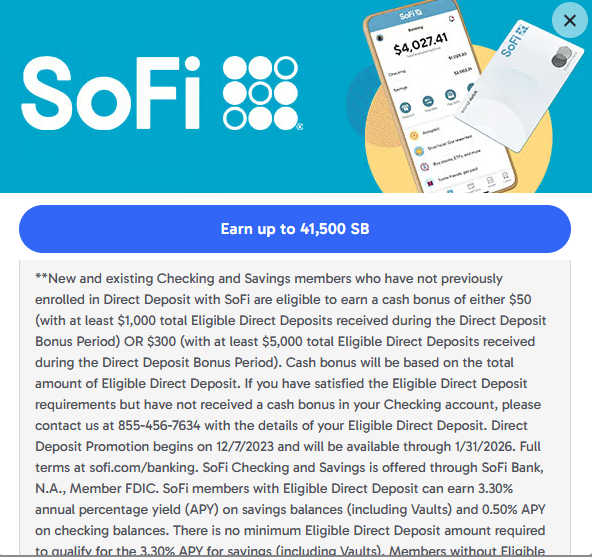
With features like a competitive APY (especially when you set up qualifying direct deposit), a large fee-free ATM network, and helpful tools for organizing your savings goals, it’s designed for people who prefer modern, mobile-first banking.
That said, the “best” bank always depends on how you handle your money—if you need frequent cash deposits or in-person branch support, a traditional bank may still be a better fit.
The bottom line: choose the account that matches your lifestyle, keeps more of your money in your pocket, and helps you stay consistent with your savings goals.
How to Make
Cash Back Work for You