

When you're struggling to pay your mortgage, there are a number of options available to you, if you face the problem head on. Contrary to popular belief, avoiding it and being in the dark is the LAST place you want to be.
Communication is key, whether you're 30, 60, or 90+ days behind on your payments. Running from your lender, avoiding their calls and letters means you're taking yourself out of the picture.
With you out of the picture, the lender has no opposition to moving toward a legal remedy.
Facing it head on, as early as possible with the right tools and resources, can help stop the threatening calls and notices, and most of all avoid foreclosure and placing your home back on track, moving forward.
How Much Equity Do You Have?
Home equity is one of the things many homeowners overlook when they fall behind on payments. But when used as a consideration, it can work to help you get back on track... in some situations—but there’s an important distinction. The mortgage servicer (also called the lender) generally does not simply “take equity” from the home and apply it to the missed payments.
The homeowner usually has to access that equity through a separate transaction, such as a home-equity loan, HELOC, refinance, or sale. And once you're already delinquent, qualifying for new financing can become much harder.
Remember, the lender is reporting any past due payments to the credit bureaus. And if you're behind on your mortgage, you may also be struggling to make payments on other bills as well.
The first conversation should usually be with the mortgage servicer’s loss-mitigation or home-retention department, not simply framed as “I want to use my equity.”
A better approach is to explain that you have substantial equity (if that's the case), you want to keep the property, and you want to know every option available to cure the delinquency.
Homeowner Resources and Tools
The resources in this section are designed to help you get organized and energized, arming you with information you can use to evaluate your own resources, speak to lenders and determine the best steps to take to get caught up with your mortgage payments.
If you’re in foreclosure or struggling to pay your mortgage, pairing these tools with a free no obligation call can help you make sense of it all. They’re all listed below for your review
- The Homeowner's Lender Call Worksheet will help you initiate phone contact with your lender and ask the most important questions. This proactive approach can get you answers quickly and possibly stop harassing calls and letters.
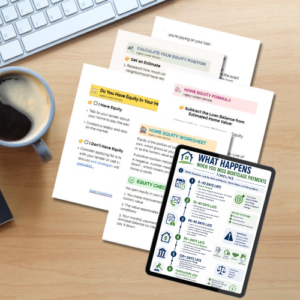
- The Home Equity Worksheet Collection helps you determine whether you have equity that might be used to bring your mortgage payments up to date.
- The Mortgage Relief Action Letter Pack helps you follow up with your lender in writing, which is the best way to communicate if time allows.
- The Simple Budget Spreadsheet is for homeowners who have no idea how much money they have to work with. It helps you determine your income and expenses, providing a remaining balance that can possibly be used to catch up on payments.
If you‘re interested in ideas for side hustles and gig work that might help you bring in extra money, check out this article.
Get our free unclaimed funds checklist to find out if there are unclaimed funds in your name. Learn where and how to search to improve your ability to find money that might be waiting.



That last part is important. If the loan is sufficiently delinquent, the servicer may require the homeowner to pay the entire amount necessary to reinstate the mortgage, rather than accepting one missed payment at a time. CFPB specifically notes that a servicer may generally require the full past-due amount after default/acceleration.
How using equity might work
As an example use the following:
- Home value: $350,000
- Mortgage payoff: $210,000
- Approximate equity: $140,000
- Past-due mortgage amount: $12,000
There appears to be plenty of equity to cover the $12,000 delinquency. But that doesn't mean the existing mortgage company will automatically advance $12,000.
There are several possible routes.
- HELOC or home-equity loan. The homeowner could theoretically borrow against the $140,000 of equity and use part of the proceeds to cure the $12,000 delinquency. A home-equity loan provides a lump sum; a HELOC allows borrowing against a credit line secured by the house.
The problem is underwriting. A lender considering a new HELOC or home-equity loan will look at credit, income, debt-to-income ratio, property value, existing liens, and recent payment history. Recent mortgage late payments can make approval substantially more difficult.
And CFPB specifically cautions people who are already having trouble paying their mortgage to speak with a housing counselor before taking on a home-equity loan or HELOC, because it creates another payment secured by the house. - Cash-out refinance. In some circumstances, a homeowner can refinance the existing mortgage for a larger amount and use the additional proceeds to resolve debts or obtain cash. Fannie Mae's current guidelines allow cash-out proceeds to be used for essentially any purpose, subject to underwriting and eligibility requirements.
For example, instead of owing $210,000, the homeowner might qualify for a new $230,000 mortgage. The old mortgage would be paid off—including amounts necessary to satisfy it—and the homeowner would have effectively converted some equity into debt.
Again, getting approved while actively delinquent is the difficult part. Many standard refinance programs require satisfactory recent mortgage-payment history. - A refinance designed primarily to replace the existing mortgage. This is slightly different from thinking of it as “taking cash out.” Fannie Mae's limited cash-out refinance rules allow a new first mortgage to pay off the existing first mortgage, including certain amounts required to pay it off such as late fees and deferred balances.
Whether a particular delinquent borrower qualifies is another question—the existence of equity by itself does not guarantee approval. - Selling the property before foreclosure. This is often overlooked when people hear “use your equity.”
If the homeowner can't afford the mortgage long-term but has substantial equity, selling voluntarily may actually be the most direct way to use that equity.
Using our hypothetical example:
$350,000 sale price
− $210,000 mortgage/payoff
− $12,000 delinquency/related amounts if not already included in payoff
− selling and closing costs
= remaining proceeds to the homeowner.
That can potentially preserve tens of thousands of dollars that might otherwise be eroded by prolonged delinquency and foreclosure-related expenses.
There may be an even better first option than borrowing
If you fell behind because of a temporary hardship but can now afford the regular mortgage payment, “borrowing against your equity” may not be the best option.
First ask the servicer about loss mitigation.
Depending on the mortgage and circumstances, options may include a repayment plan, payment deferral, loan modification, forbearance, or another workout arrangement.
For example, under a repayment plan the missed amount is spread over future payments rather than requiring the homeowner to borrow against the house.
The Mortgage Catch-Up Planning Kit
A 7 page system is designed to help you know what may happen at each stage as you navigate past due mortgage payments. Discover how to protect yourself using informative resources.
Price: $25.99